Share article
Induction cookware guide: How it works, what cookware you need, and how to cook with it
Share article
With the right cookware, induction is a simple way to make everyday cooking more efficient. Here we answer every question you’ve ever had about cooking on induction.


 Translation missing: en.accessibility.product_link
£350.00
Space Steel Folding Handle 3-Piece Saucepan Set


Traditional gas or electric hobs can be slow to heat up and hard to clean. Induction cooking delivers fast heating, precise temperature control and an easy-clean glass surface.
How does an induction hob work?
Unlike gas and electric hobs, induction works thanks to a magnetic field that heats the pan, not the hob surface. This makes it different from gas and electric hobs, and means the pan needs a magnetic base to heat up properly.


What is induction cookware (and do you need special pans for an induction hob)?
Induction compatibility involves a pan that has the right base design and hob zone size to work with the core requirement for induction cookware which is a magnetic/ferromagnetic base. While you don’t need special pans for an induction hob, you do need to make sure that the pans you buy are compatible.
All Joseph Joseph cookware is compatible with induction, except for our smallest 20cm frying pan which is too small to meet the magnetic base requirement. The Space Steel range features an even-heat aluminium core for optimal cooking, and works brilliantly on induction.


-


Space Steel Folding Handle 20cm Frying Pan
£92.00 -


Space Steel Folding Handle 24cm Frying Pan
£100.00


-


Space Steel Folding Handle 28cm Saute Pan & Lid
£150.00


FAQs
How to identify induction cookware
Not all cookware works on an induction hob. You can check whether yours will with a magnet: if the magnet sticks firmly to the base of the pan, it’s a good sign of induction compatibility.
What pans work on an induction hob?
The best pans for induction cooking include magnetic stainless steel, such as Space Steel, cast iron, and carbon steel. A flat, smooth base is important as this helps the hob detect the pan and ensures even heating.
What pans don’t work on induction?
Non-magnetic materials such as glass cookware, ceramic cookware, and copper and aluminium pans without an induction base won’t work on induction.
How to cook on an induction hob
Induction cooking is fast and energy-efficient. To start, place an induction-compatible pan on the hob and select the cooking zone. Choose your heat setting, then adjust the temperature as needed during cooking. Because induction head the pan not the hob, temperature changes happen almost instantly, so less heat is wasted. You may find you need to cook on a lower heat setting than you are accustomed to.
Can you use induction pans on a normal hob? (gas/electric/ceramic)
Induction cookware can usually be used on gas, electric and ceramic hobs without any problems. Because induction pans are usually built with multi-layer bases, they’re designed to perform across different heat sources. Check the manufacturer’s instructions on your specific cookware to confirm whether it’s hob compatibility.
How to clean an induction hob
One of the most attractive features of cooking on induction is how easy the hobs are to clean. Because the surface doesn’t get as hot, spills are less likely to burn and become difficult to budge. The cleaning process involves allowing the hob to cool, wiping away any loose debris, and cleaning with a sponge and hob cleaner. You can buff dry with a clean microfibre cloth to finish. Abrasive scourers or harsh chemicals may scratch the glass surface, so avoid cleaning with these.

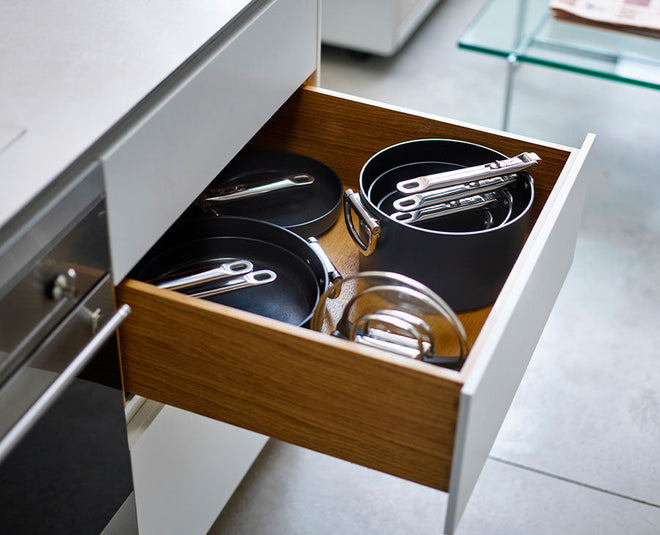
Too many pans. Not enough cupboard. Solved. Discover high-performance, non-toxic cookware with folding handles for easy storage.

Shop clutter-free cookware
£295.00
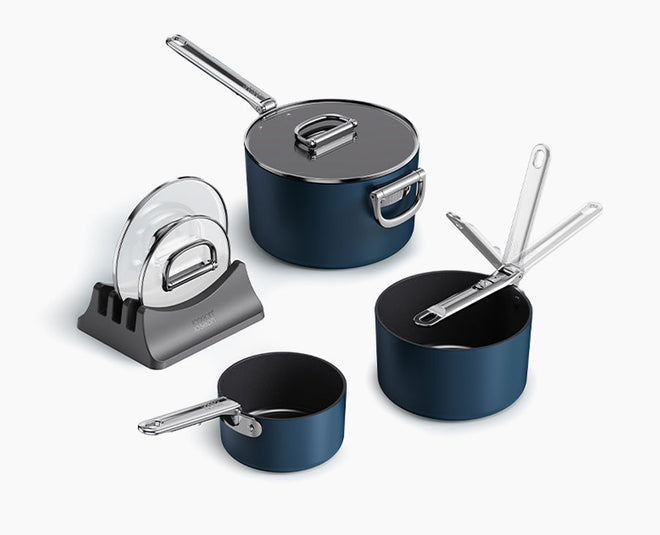
Space Folding Handle Ceramic Non-stick 3-piece Blue Saucepan Set


£555.00
Space Steel Folding Handle 5-Piece Cookware Set


£225.00
Space Steel Folding Handle Non-Stick 2-piece Frying Pan Set


£100.00
